
Global gathering reflects on Nicaea through the lens of empire

Seventeen centuries after church leaders gathered to settle theological disputes, a new kind of ‘council’ met. This time in Türkiye, not to define doctrine, but to question what it means to believe in “one Lord, Jesus Christ” in the 21st century. A world of empires and power struggles, environmental destruction, and growing inequality.
The Council of Nicaea in 325 AD is remembered for uniting a fractured church around a common Nicene Creed. But at what cost? With Emperor Constantine involved, questions remain about whether the Council spoke purely for the Church or also served imperial interests. And today, as faith is often co-opted by nationalism, capitalism, and climate denial, are we repeating the same mistake?
Organised by USPG, the gathering brought together theologians, poets, priests and church leaders from across continents and traditions, including participants from India, Aotearoa New Zealand, South Africa, Panama, Greece, Zimbabwe, Brazil, Canada, and the UK, representing Anglican, Orthodox, Baptist, Methodist, Reformed, and United churches.
Hear the Creed recited where it all began
The group also visited the site at Lake İznik, where archaeologists believe the First Council of Nicaea met in 325 AD and where the Nicene Creed was first proclaimed. The ruins of the basilica now lie partially submerged beneath the waters of the lake, a poignant reminder of history resting quietly beneath the surface. There, participants heard the Creed recited, connecting with the moment where it all began.
Click here to read the full reflection : ‘ReStorying Nicaea: In the Empire, but not of the Empire?’
Leia esse relatório em português
What emerged from this new gathering was not a rejection of the creed, but a re-reading. Not a rewriting of words, but a rediscovery of the spirit behind them. Some turned to the ancient Greek – pantokrator, not “almighty” as in imperial force, but “the one who holds all things,” tenderly, like a mother holding her child.
Others listened to the land. From Panama, the Guna people offered a “Credo of Interwoven Life,” where divinity is not locked in hierarchy, but dances in the breath of trees, rivers, ancestors. Māori voices spoke of the silencing of Wairua, the feminine spiritual presence, by creeds carried on colonial tongues.
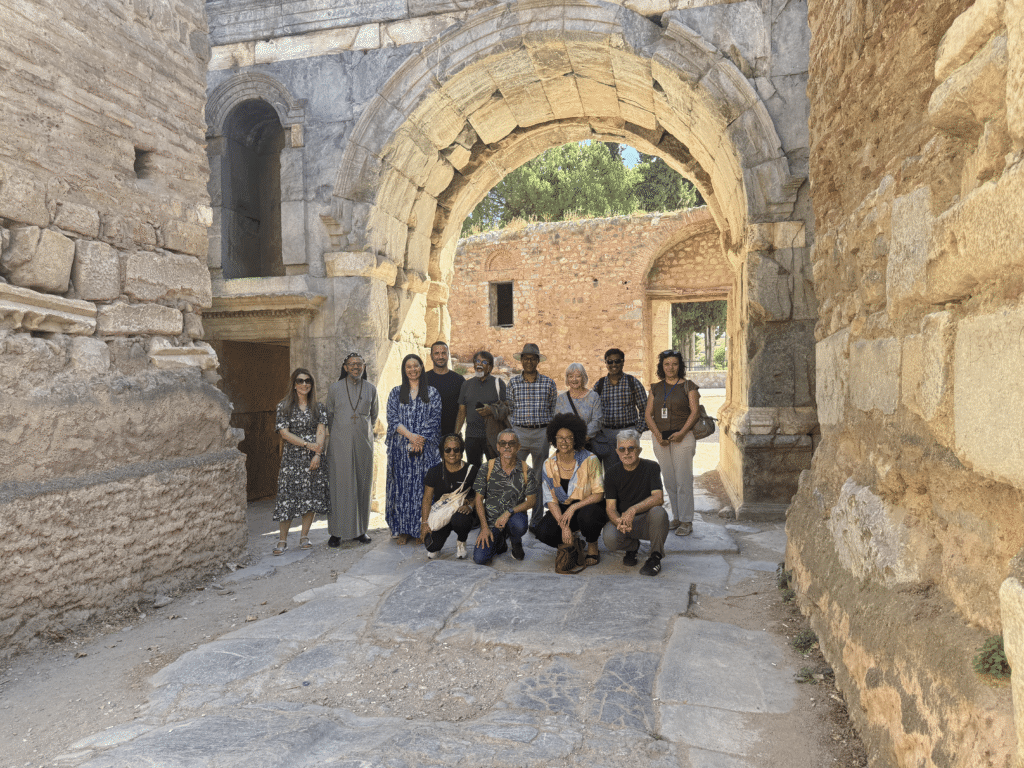
And still, the group prayed. They walked the ruins of ancient Nicaea. They recalled that the creed was never meant to be a weapon, but a declaration of shared belonging. “One Lord,” not the many lords of empires. Only Christ, crucified by the state, risen with scars, calling us not to dominate but to serve.
They remembered, too, that the same creed has been spoken by both oppressor and oppressed. In apartheid South Africa, both torturer and tortured claimed loyalty to the same church and broke the same bread. The challenge is how to live faithfully in that tension without erasing the wounds it reveals.
The Nicene Creed, 1700 years on, still unites the body of Christ. Yet this summer in Türkiye, through the voices and experience of those gathered, it was given new life. It was, in the words of The Revd Canon Dr Peniel Rajkumar, USPG’s Global Theologian and Director of Global Mission,
A moment of re-receiving our common faith in our uncommon times, so that this faith can be embodied and enacted in ways which, following Jesus, say a resounding no to empires both past and present and a resilient yes to all that affirms life.
Question to consider: Which part of the Nicene Creed stands out to you?

We Believe – Study Guide
Dig deeper into the Nicene Creed with our new six-session study course ‘We Believe, We Belong?’ now available to order or download.
Click here