
Readings: Job 38, 1, 4-11; Acts 27:27-44
On a Sunday in May 2024, I was in a car park in Calais with a group of refugees largely from Eritrea and South Sudan. It was Orthodox Easter: We danced to music from a car stereo, shared Eritrean food, prayed. The prayers were led by a young man, in his early 20s, called Amanuel – the Eritrean for Emmanuel – ‘God with us’, language for Jesus we associate with jolly Christmas carols. I was visiting the work of a project that the United Society Partners in the Gospel, the Anglican mission agency I lead, had set up with the dioceses of Canterbury and Europe. The refugee situation in Europe is, of course very complex, but as our young Anglican Refugee Support Lead puts it to me last week: ‘we have to be OK with complex; we have to be OK with nuance’. Our job as church is to be the human face – to provide care and compassion; shelter and security if possible, fresh water, food, clothes – and a wide range of other forms of support, including supporting families who had been bereaved.
Inevitably, conversation was hesitant and guarded, on both sides. Having fled violence and brutality, those we were with had already travelled over 5,000 miles: People on a journey they had hopes, as English speakers, to cover a few more miles across the channel – that they might arrive somewhere they could learn to call – in time – home. A place we could leave for at the end of the day via the Eurotunnel with the minimum of inconvenience.
A year on, last week, I was in Canterbury cathedral for Refugee week and in the Crypt, where, our Refugee Support Lead had created simple memorial boards to remember all those who had drowned, or died on French soil, partly as a result of increased security measures1. The boards recorded their names – and ages: 21, 23, 32, 17, 14, 7, 6 and most pitifully, one hour – in most cases the full name, but in some just Muhamed, Sara, and in a handful of cases, there was no name. I looked anxiously, and was naturally relieved not to find an Amanuel on the Boards, but my feelings of relief were trivial in the face of the 498 people known to have died since 1999; with 2024 being the worst year with 89 deaths.
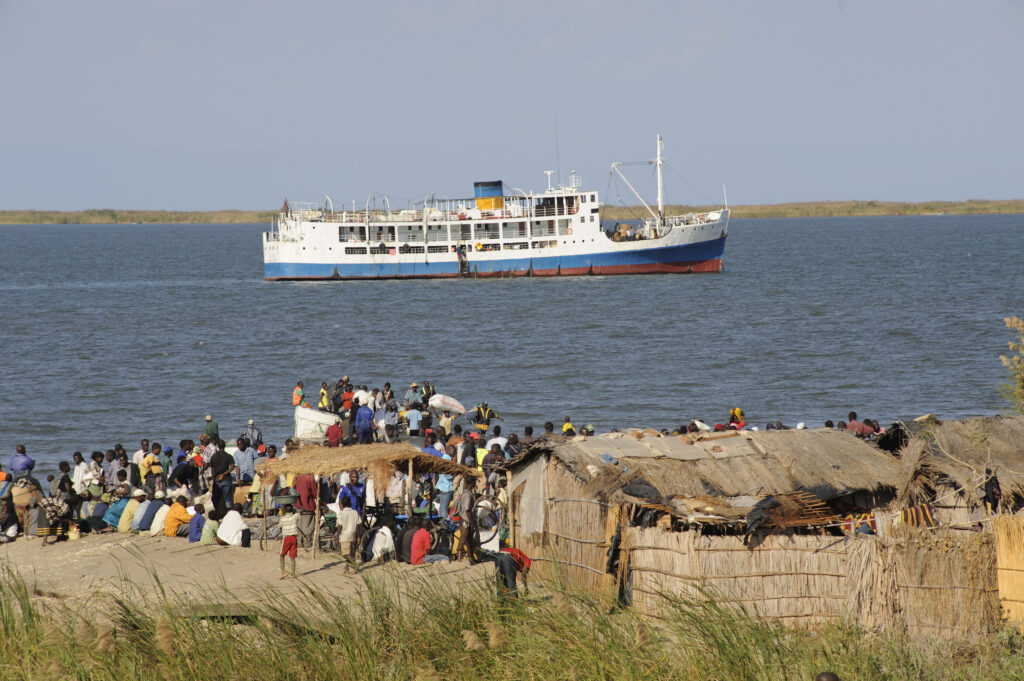
Today’s reading gives us the closing extract from a classic ancient Mediterranean Sea adventure or misadventure. I love the technical and human detail of this managed shipwreck with its four-anchor technique and the unusual anchoring from the stern. It is October, right at the very end of the season which the ancients regarded as safe for travel – no-one sailed from November to February. The ship is an Alexandrian grain ship, part of the state sponsored trade supplying grain for Rome. But it also doubled up as a prison ship with Paul and others under military guard to be delivered to Rome. Classic maritime activities.
Things have been going badly wrong and we join the story as panic is setting in – people are turning to their own self-interest – the sailors try to do a bunk in a boat confident in their skills to survive – but they are brought back into line by the soldiers, ignorant landlubbers, who stupidly exacerbate the situation by cutting the boat loose. A little later, fearful they will be blamed if the prisoners escape, they make to execute them. Throughout, however, Paul, who has gained the confidence of the senior officer; is determined that all will survive and come safely to shore. But that requires strong moral leadership in a context in which all have different investments, anxieties and needs – and, frankly, a great deal to lose. The captain his cargo of wheat which will have consequences; the soldiers a severe punishment for losing their prisoners, the sailors their lives and probably pay. Paul appeals to the common good, to the reality – literal and moral – that they are all ‘in the same boat’. And through quick and effective decision-making and a fortifying, spirit-lifting shared meal in which they eat together as companions – literally, those who break bread together – they are united and strengthened for what lies ahead.
It is a commonplace to say that as human beings we are all ‘on a journey’. But it is, of course, true. The maritime experience, being ‘in the same boat’, however, heightens our awareness of this reality and can deepen our sensibility. At sea, the stakes are higher, the risks greater, the dangers ever-present. The sea has a way of making things more obvious, things we take too easily for granted on shore: the importance of engaged, responsible leadership; of everyone knowing their role and doing it; of collaboration. Indeed, the maritime environment fosters a collective senseof how to live together in a space, sometimes, literally, how we stand or move in relation to one another. As a result, the laws of the sea are different. In particular, the obligation to aid people in distress; that rescuing souls ‘in peril on the sea’ is a fundamental human duty.
We live in a world, today, which presents us with real challenges, which are inherently complex and difficult to address: the climate crisis, the unprecedented movement of people driven by conflict, but also environmental pressures, the shifts in geostrategic power, the dilemmas around national and indeed maritime security in a world with new geographical realities. And it is a world increasingly difficult to navigate in an age of populist politics and polarising forms of media – with disinformation, deepfakes, deception. Yet it is a world which calls out for the exercise of moral leadership at all levels – bold, humble, and collaborative. Leadership that speaks not the easy attractive word but rather the complexity of real lives and situations seeking solutions, building consensus and cherishing the common good.
Being ‘in the same boat’ means having a deeper awareness of each other; coming to understand we sail the same turbulent waters in this world, facing the same challenges albeit from different angles, and having an obligation to reach out to others in distress: There is something profound about a maritime outlook that has much to teach us and equip us in all the many dimensions of our lives as human beings, in the city as well as on the sea,
It is not simply that the world would be a better place if we thought a bit more about others. The point is rather that if we recognise the investments, the anxieties, the needs of the other (whoever they be – the Filipino sailor, the Mayor, the cadet, the businesswoman, the alcoholic, the lonely widower, the Eritrean refugee), and if we take onboard that recognition and awareness so that it becomes part of our journey, our story, then through humility and empathy, we will step deeper into our own humanity and become the relational speakers, the creative agents, the cooperative persons, the bold leaders, that we can be. And that we have to be, if we are to live and to know ourselves as a part of something larger, something greater.
Of course, we always have the option to simply journey through life as the heroes of our own stories without looking to others or the wider horizon, but if we do so, we will become smaller, more timid, more brittle people – and we will fail to see in our sisters and brothers their deep precious worth as children of God, like us – Emmanuel, God with us, truly with us in the salt and the swell, in the waves and not simply the harbour. Amen.

By Revd Canon Dr Duncan Dormor
General Secretary, USPG and Canon Theologian of Portsmouth Cathedral.
The 1985 State of Emergency marked a pivotal moment in South Africa’s apartheid era. Many participated in the struggle from different places—some directly and others through advocacy, prayer, and protest abroad. As a young person, I joined marches, church services and vigils in London, so I was eager to attend this webinar and learn more about the Kairos document and its legacy 40 years on from its publication.
In the latest FeAST webinar, hosted by USPG, South African poet, theologian, and Senior Researcher at the Desmond Tutu Centre for Religion and Social Justice, Dr Thandi Gamedze, took participants on a powerful and thought-provoking journey towards liberation in South Africa and the birth of the Kairos document – written by black South African theologians amid the turmoil of the 1985 State of Emergency. It is a manifesto that boldly confronted the church’s complicity with the apartheid regime. She explained that the theology of the Dutch Reform Church provided justification for the apartheid system and that the Kairos document offered a liberation theology coming from oppressed people.

Thandi invited participants to reflect on how, four decades later, the global Church still faces urgent questions about its role in supporting or resisting today’s structures of oppression. She said,
In these times, recalling the often-marginalised histories of church resistance to oppression can help us to remember our prophetic role as the church, and can provide imagination for faithful church responses to the broad-ranging crises that we are currently living through.
Participants discovered important people, organisations, and moments that shaped the fight for liberation in South Africa by playing an interactive game Thandi developed, called Freedom Theologies: South Africa. It allows people to explore the stories of how South African Christians and their allies resisted apartheid.
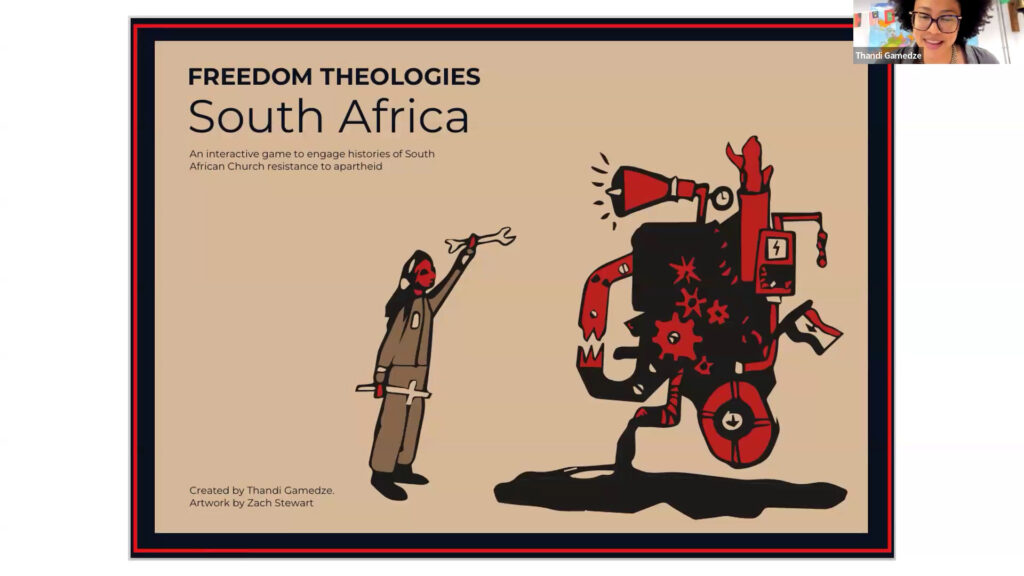
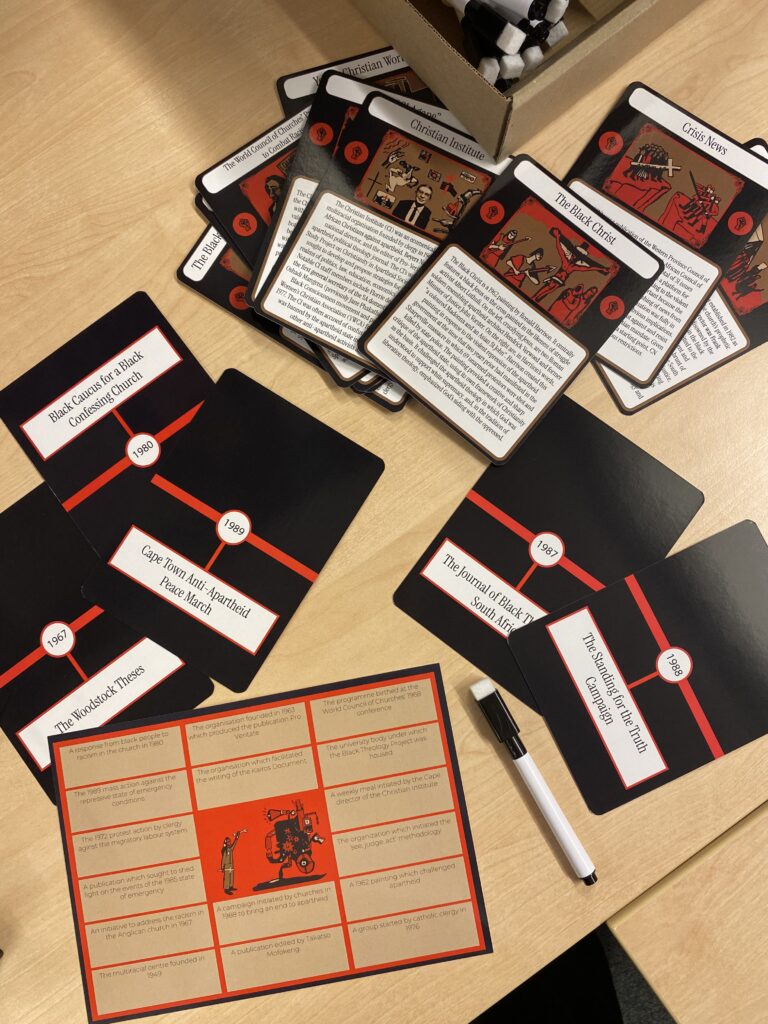
Thandi spoke about the inflated role in the liberation struggle that today’s church claims to have played. “Yet, often the actual stories are unknown. There is a need for faithful remembering of our work as the church today in our contemporary struggles,” she said.

By Sophia Jones
Sophia Jones is a Communications professional with over 30 years’ experience working with global charities. She served as Horn and East Africa Communications Manager for the International Rescue Committee in Kenya and, later, Senior Communications Manager at Mothers’ Union then as Director of Communications for the Diocese of Southwark. Since going freelance, she has supported various organisations including the Anglican Communion. Passionate about gardening, Sophia also contributes to her local church and enjoys time with her three grown up children.
As someone researching my Jamaican ancestry, I eagerly anticipated this FeAST webinar. The Anglican Church in Jamaica has been intertwined with my ancestors’ lives since the mid-1800s and most likely earlier, with St Stephen’s Parish Church in the small rural town of Nain, documenting their baptisms, marriages and deaths.
The Revd Garfield Campbell’s presentation has given context and history to my personal research. He divided it into three parts: firstly, the history of the diocese of Jamaica, secondly, the role of its first bishop Christopher Lipscomb, and finally its evolution to the present day.
The Church of England (the Established Church) in Jamaica was born in 1664. It wasn’t until 1824 that the dioceses of Jamaica and Barbados were established by the British government to appease both the anti-slavery advocates and those who supported slavery. Bishop Christopher Lipscomb, who was answerable to the British government, was given the mandate to instill religious and moral instruction to the enslaved people who were restless and enlivened by the anti-slavery debates, while at the same time safeguarding the interests of the slavers.

Garfield explained that because of the many challenges he faced, Bishop Lipscomb built an ecclesiology (that is, a study of the Church) based on compromise operating from a position of domination which prioritised the enslavers over the enslaved. There were some clergymen, schoolteachers, and catechists who worked to improve lives. Enslaved people saw baptism and confirmation as a means of obtaining minimum protection. Marriage, for example, provided legal protection from being sold to separate enslavers. Post-slavery, baptism facilitated access to better-funded schools run by the Established Church.
Today, the Anglican Church in Jamaica is often seen as a church for the wealthy, a perception rooted in its history and, according to Garfield, not entirely accurate. However, he noted some people’s unease surrounding Archbishop Justin Welby’s presence at the Diocese’s 200th anniversary celebration, reflecting lingering historical tensions.
Garfield hails from Nain, the same rural community as my parents and ancestors, and is a second-year PhD researcher at the University of Leeds, studying 19th-century Anglican missiology in Jamaica through conversion, power, and agency. In his summary, he questioned whether the Anglican Church in Jamaica can overcome the perception some people have of it. He believes it can but “it will require open honest and genuinely democratic self-examination rooted in an acknowledgement of a compromised past which has leaned more towards the side of the oppressor rather than the oppressed.”
Watch the full webinar here: https://uspg.org.uk/feast/webinars/
By Sophia Jones
Sophia Jones is a Communications professional with over 30 years’ experience working with global charities. She served as Horn and East Africa Communications Manager for the International Rescue Committee in Kenya and, later, Senior Communications Manager at Mothers’ Union then as Director of Communications for the Diocese of Southwark. Since going freelance, she has supported various organisations including the Anglican Communion. Passionate about gardening, Sophia also contributes to her local church and enjoys time with her three grown up children.
The telegram arrived early on Good Friday 1980. It informed me that my bishop had decided to sponsor me to train to be a priest. The very next thing in my diary that morning was to carry the processional cross for the sung liturgy, as all around me the choir of King’s College, Cambridge, where I was researching in mathematics, sang Allegri’s setting of the Miserere. It struck me then, that the message I had just received was my calling to hold up the cross of Jesus before God’s people not just for an hour one Spring Friday morning but for the rest of my life.
What had drawn me first to the Christian faith, and then on to seeking ordination, was the powerful sense I had of the God who, in Jesus Christ, knew me better than any earthly person, and at the same time loved me more deeply than any human being ever could. Jesus showed that limitless love throughout his ministry. He healed the sick, freed those held captive by evil, listened to the voices of outcasts, confronted the perpetrators of injustice. Above all, he forgave sinners, often even before they had plucked up the courage to repent.
This was a Jesus I wanted both to follow and to hold up so that others like me could come to know him, or to know him better. This was the forgiveness and love he showed supremely that first Holy Week, when on what Christians now call Good Friday, he allowed himself to be murdered for love of you and me.
Nailed to the cross, Jesus proved conclusively that his love and forgiveness had no limits, not even death itself.

By The Rt Revd Dr David Walker
Bishop of Manchester and Chair of Trustees, USPG
2025 marks the 1700th anniversary of the first Ecumenical Council convened at Nicaea in AD 325, a landmark moment that profoundly shaped Christian doctrine and unity. At its heart is the Nicene Creed, a declaration of faith embraced by Christians across the world.
To celebrate this enduring legacy, USPG has produced a video that features a global compilation of people and church partners declaring their belief by reciting the Creed. Among these voices are speakers of Twi, Bengali, Nyanja, Arabic, Spanish, and Welsh, alongside English spoken by believers from the Middle East, Zambia, and the Solomon Islands. Together these voices reflect the amazing linguistic and cultural diversity of the Anglican Communion, as well as the wonderful reality of one shared faith.
This video is both a celebration of shared belief and an exploration of diversity, encouraging reflection on how this foundational text continues to shape Christian identity and foster connection across cultures and generations.
Watch now and hear the Nicene Creed like you’ve never heard it before!
A Simple Guide to the Nicene Creed
To help you unpack the Creed, check out our study guide: ‘We Believe’. Contributors from the Philippines to the Middle East track key elements of the Creed including the nature of Jesus, His resurrection and the power of the Holy Spirit. The questions and prayers encourage meaningful discussions around unity, diversity, and how we can live out Christ’s message of love and justice today. Click the link below to order or download a copy for free.

In the heart of Doha, where cultures and faiths intertwine like threads in a grand tapestry, I have the privilege of serving as an administrator and the Secretary to the Senior Priest at the Church of the Epiphany, The Anglican Church in Qatar. My role extends beyond managing schedules and logistics—it is a sacred calling to cultivate a space where faith flourishes, where a global community of believers stands as one family in Christ. Being a Christian in this land is a quiet yet profound pilgrimage, one that calls for patience, wisdom, and an open heart. Each day unveils a new lesson in trust and service, revealing the depth of what it means to walk in faith where Christianity, though a minority, is embraced with dignity and respect.
Qatar, with its deep Islamic heritage, has extended a gracious hand, offering Christian communities a safe and structured space for worship. The Religious Complex in Doha, fondly known as “Church City,” stands as a luminous symbol of coexistence—a place where believers from across the globe gather in devotion and gratitude. The Church of the Epiphany, where 57 nationalities worship side by side, embodies the richness of diversity, while the Anglican Centre, home to 90 churches of various denominations, testifies to Qatar’s commitment to religious harmony. In a world where religious freedom is often fragile, we give thanks for Qatar’s openness and protection, allowing our Christian community to thrive in faith, unity, and peace.

One Church, Many Nations: A Friday service at The Church of the Epiphany, Doha
The ‘Whom Shall I Send?’ Young Adults Conference in 2023 stirred something deep within my spirit, calling me to pause and truly listen—to God, to my own calling, to the whispers of divine purpose. It was through this sacred encounter that I was encouraged to embark on a journey I never envisioned—studying Theology.

Joyaline, pictured front left, with fellow ‘Whom Shall I Send?’ participants and clergy from the Province of Jerusalem and the Middle East.
Yet it was on the ‘Whom Shall I Send?’ programme in Cyprus the following year that I truly learned the grace of waiting. We “sat” under the tent of Abraham and Sarah (Genesis 18) and saw how their story is one of trust, hospitality, and unwavering faith in God’s promises. Hospitality is not merely an act, but a spiritual discipline, one that has shaped my own faith journey. Each encounter with a stranger feels like God retelling my story—reminding me of His guidance, reshaping my perspective, and redirecting my steps toward His purpose. As Hebrews 13:2 (NRSV) beautifully reminds us, “Do not neglect to show hospitality to strangers, for by doing that some have entertained angels without knowing it.”
What once seemed like a mere administrative role has unfolded into a divine vocation. In a land where Christianity is a treasured privilege, my work supports a mission far greater than myself.
Through worship, service, and silent witness, we stand as a testament to the enduring strength of the Christian faith. Peacemaking and interfaith dialogue have deepened my understanding of what it means to embrace differences and walk forward in love, as Jesus taught in Matthew 5:9: “Blessed are the peacemakers, for they will be called children of God.”
Here in this land, our faith flourishes not because of our numbers, but because of God’s boundless grace. The Church of the Epiphany, with its vibrant and diverse congregation, is a reflection of the global body of Christ—united not by geography but by a shared faith in the One who calls us His own. In this sacred space, I am reminded that God’s kingdom knows no borders, and His love is limitless.
As we wait, may we do so with expectant hearts. As we welcome, may we do so with open arms. And as we walk forward in faith, may we tread the path with courage, knowing that the One who calls us is ever faithful.

By Joyaline Rajamani
Church Administrator and Secretary, Church of the Epiphany Doha, The Anglican Church in Qatar
Originally from the hills of Kandy, Sri Lanka, and nurtured by the Holy Trinity Church, Wariyagala, Joyaline grew up serving in ministry – teaching Sunday School, leading youth, interpreting sermons, and adorning the church for festive seasons. Now, as Church Administrator and Secretary to the Senior Priest at the Anglican Church in Qatar, Joyaline’s role blends logistics and schedules with faith, service, and hospitality to a large multi-national congregation.
In my ‘day job’, I have the huge privilege (and pleasure) of working with senior leaders, lay and ordained, across the Anglican Communion, and of learning something of the challenges that face the member churches of our wider Fellowship.
These really are hugely varied: In some cases it is working with communities under regular threat from natural disasters during the hurricane season in the Caribbean or being subject to multiple typhoons in the Philippines. In these cases, houses and schools and livelihoods have to be rebuilt from scratch – and bishops and other leaders have a crucial role to play in encouraging communities in the ways of hope and resilience, in addition to galvanising practical support, locally and internationally.
In other churches, especially in much of Asia, Christians are often in a small minority and from marginalised ethnic groups or castes, and face active discrimination or persecution.
Then there are the ongoing ‘business as usual’ challenges of working within corrupt political and unstable economic conditions which make clergy stipends or housing or pensions (along with those of the majority of the congregations they serve) precarious – or in some cases, non-existent. And I haven’t even scratched the surface in terms of the challenges posed by war or chronic violence; of what it means to ‘be Church’ in the Congo, Myanmar, South Sudan or Gaza.
Everyday basic realities are rarely examined. They just are. But they too can create significant pressures. Some flow from geography: Leading a diocese that may take a couple of days to travel across (rather than an hour or two) – problems familiar to those in Brazil or Botswana or Madagascar. Others from issues of communication and mutual intelligibility. Polyglotism is the norm not the exception: Most churches serve multiple language groups and some operate with liturgies in a range of official languages: The Prayer book of Southern Africa is currently printed in nine languages. In South India, there are four main languages in addition to English (Telugu, Tamil, Malayalam and Kannada), however the number of languages spoken across the region is in the hundreds.
This is just a quick snapshot of what bishops have to navigate – alongside the internal politics and tensions of the institutional and communal dimensions of ecclesial life. And of course, it is the latter which (almost) always generates the most disturbing challenges for any church.
The Church of England at the national level is very obviously in need of systemic change. That has been true for quite a while. And it is within this frame that we should approach the oft-repeated statement about the Archbishop of Canterbury, ‘it’s too big a job for any one person’. Clearly the issue isn’t one of scale (see under ‘the Pope’). There are clearly powerful arguments for separating the Archbishop of Canterbury’s responsibilities to the Church of England from the Communion-wide role – though I’m not completely convinced that this is where the real issue lies.
Over the last seven years I have attended provincial synods across the Communion in wonderfully diverse contexts. I have enjoyed learning something of the different ecclesial politics in operation, not least of how primates and bishops are elected, or exercise authority within different churches – sometimes with great sophistication and wisdom. Inevitably, those conversations involve the articulation of broader cultural and political considerations within which episcopal authority is exercised.
Unsurprisingly, I am often drawn into conversations where I am asked to explain or interpret one church to another – rarely in terms of the formalities (canon law, etc) but rather – what really happens and why. And within all of this – the Church of England is a complete outlier. Nothing can illustrate this more clearly than the task of trying to explain to fellow Anglicans – many in countries which were formally part of the British Empire – why the committee responsible for appointing the next Archbishop of Canterbury is chaired by the former head of the State’s domestic intelligence service, MI5. To many, where a primate is simply elected by his or her fellow bishops, such deep entanglement with the State is incomprehensible, frankly ‘lost’ – without trace – ‘in translation’.
The challenge for the Church of England at the national level is not one of strategy, but of organizational culture – or rather cultures. When looked at from outside the UK this seems obvious. The Church of England’s organisational culture is too dependent on, and derivative of, institutions that form an integral part of the British State: Our Synod has shrined ‘a quasi-parliamentary form of institutionalised conflict’ with Church House an attempt at a centralised civil service for an organisation with 42 semi-autonomous regions each with its own county leader, aka Diocesan bishops. If you also throw into the mix an archiepiscopal court across the river – need more be said?
When any organisation faces a serious, even existential, crisis it has to have the humility to ask fundamental questions and to look beyond itself for models and examples. Not simply to copy or import them (the wholesale importation of ideas or practices really doesn’t work) but to ‘think with’. We are part of a global communion, so if, in the Church of England, we are serious about reviewing and refreshing the culture at the heart of our national church, we may need to overcome that characteristic British myopia and look beyond La Manche at our sisters and brothers and how they organise their lives together as Christians – in most cases with significantly less resource that we are privileged (and burdened) to carry. The humility and courage to walk this road may be one of the most important qualities in a new Archbishop.

By The Revd Canon Dr Duncan Dormor
General Secretary, USPG