
Legacies of History
Delve into the legacies of slavery in The Anglican Church in the light of our Christian faith.
Introduction
Nowadays, many people are beginning to discuss and unravel the deeply entangled histories of the Church, the transatlantic slave trade and racism. It is a painful, but vital process especially for Christians of African or Caribbean descent who may have personally experienced racism. For all Christians, pursuing racial justice is part of living out a faith rooted in justice, repentance, and reconciliation.
Legacies of History is a thought-provoking resource that invites us to reflect honestly on the Church’s complicity in slavery and empire, using the Codrington Estates in Barbados as a case study.
The workshop material seeks to stimulate these conversations within your local communities, dioceses and churches – creating space for and informing the process of education, reflection and ultimately, action in response to these legacies.
While the scale and breadth of these histories can feel overwhelming, this resource hopes to show that all change starts locally once a community of voices come together.
To begin, watch the video below:
Video Transcript
I am The Revd Dr Rachele Evie Vernon O’Brien, a Jamaican theologian. I invite you to listen to four Caribbean voices, mine, and those of The Revd Dr Sonia Hinds, Mr Llewelyn Arthur and The Revd Levon Alkins, as we present this USPG sponsored resource, Legacies of History.
As humans, we generally want to leave the finest inheritance we can for the generations to come. What we pass on is shaped by the legacies we have ourselves received. In the present, we must examine what we have received from the past to repair what needs to be repaired so we can hand on the best to the future.
And so, we invite you to join us in this examination of our legacies in the light of our Christian faith. We encourage you to approach this glimpse into our collective history in the spirit of confession of the ways in which we have gone wrong, so we can receive absolution from God, our beloved parent and go on to avoiding the errors of the past so we can do better.
For over a hundred years the Society for the Propagation of the Gospel, a Church of England mission agency, owned human beings on the Codrington estates in Barbados. We will be using the Codrington case to reflect on the wider legacy of the Church’s complicity in the project of slavery and empire and the consequences across the world for us today.
To prepare this resource, people from the island of Barbados, where the Codrington estates are located, shared with us their perspectives on the impact of this legacy on their lives and on their faith.
User Guide
You can engage with Legacies of History in a way that suits you:
- Order a free copy and run a workshop series in your church, diocese, college or other small group. Or get in touch and we can come to you!
- Follow the accessible transcripts and audio recordings available here on our website.
The resource offers thoughtful discussion questions to help you explore the material. The Guide for Facilitators also includes a ready-made workshop plan with suggested timings, and an order of service to begin your time together in prayer and reflection.
Session One – Empire Story
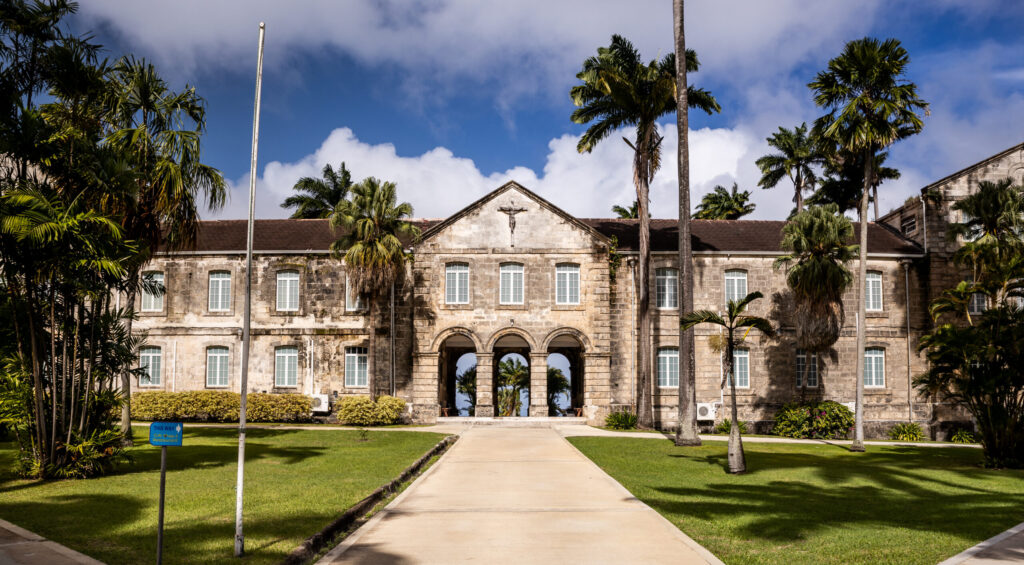
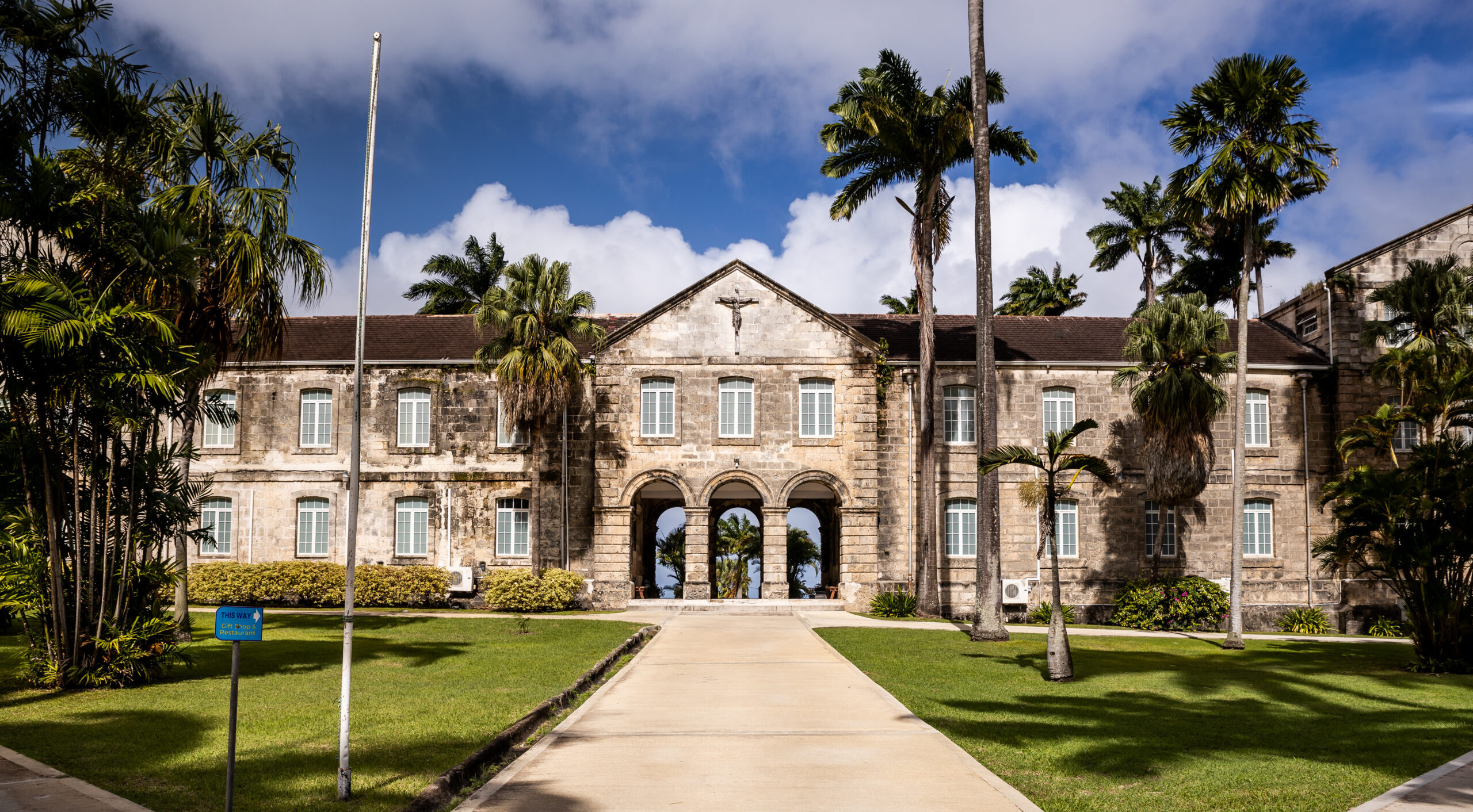
Image: Codrington College, Barbados
The Revd Canon Dr Sonia Hinds is a graduate of Codrington College and Rector of St Leonard’s Anglican Parish in the Diocese of Barbados.
Listen to the sound clip (approx 8 mins)
Audio Transcript
From the late 15th century onwards, the whole world either came or was brought to the region we call the Caribbean, named after the indigenous Caribs. The Europeans called the region the West Indies basing that name on the curious fact that Christopher Columbus, an Italian explorer, funded by the Spanish government, thought he had reached India by sailing west from Europe. The Caribs and other indigenous people, whom Columbus called ‘Indians’, were swept aside. Their land was taken away, and they were forced to labour for the benefit of the Spanish invaders and for the waves of Europeans who followed, determined to enrich their ruling classes by extracting everything they could from these territories.
Empires are not new, nor are they confined to the annals of European history. What is remarkable about this iteration of an age-old system is the scale and geographical reach of empire. Nations vied for control over the resources of territories thousands of miles from their own homelands. European powers reorganised the world to suit their own interests. They imposed borders on countries based on their own territorial conflicts. Their military might and large ocean-going vessels made it possible for them to move thousands of people from one part of the globe to the other to fund large scale economic ventures for their own benefit.
In the West Indies, the European powers eventually decided that the most profitable economic venture was sugar cane, and, having destroyed the local populations, the most cost effective way to make money from this venture was to fund the kidnapping of human beings from Africa, ship them across the Atlantic and use them to labour in the fields until they died. These few sentences hide an ocean of pain in the devastation and destruction of African society, the degradation of the transport across the ocean and the brutality of a life of slavery.
At the height of the transatlantic trade in human beings, the British were the largest traders and made the most money, outperforming even the French, the Spanish and the Portuguese who had an earlier start. When the British, both for economic and moral reasons, decided to end the trade in 1807 they and other European powers continued to engage in relocating workers from other parts of the world, notably from Madeira, China and India to work on the plantations as indentured servants. These people were not quite slaves, although they worked without pay or many rights for several years to pay back for their passage and living costs. They were not stripped of their identities and could expect to be free after their term of service was completed. Many European countries used a system of indentured servitude to move some of their own populations who they deemed problematic because of religious, political or economic reasons overseas. Indeed, the word ‘Barbadosed’ was coined to refer to Irish and Scottish people sent to labour in the colonies. Indeed, the world was brought to the Caribbean.
As for empire, while most European countries were involved in the project of extending their dominions, the British managed to construct purportedly the largest empire ever seen, one on which, by 1919, the sun literally never set.
The church in its many forms, whether Catholic, Reformed or Anglican, blessed the European project of empire and the trade in enslaved human beings. In the 15th century, the Roman Catholic Church promulgated the ‘Doctrine of Discovery’ which maintained that native peoples had no right of ownership over their lands and that European nations could legitimately claim any of it for themselves. Protestants, while decrying other aspects of Catholicism, warmly embraced these ideas as well. Indeed, in 1823, the American government adopted this principle into law. The Vatican repudiated this doctrine in 2021.
It is against this background that the Society for the Propagation of the Gospel (SPG), a mission agency of the Church of England, accepted ownership of the Codrington estates in Barbados, along with the kidnapped and enslaved Africans on the estates. A planter, Christopher Codrington, had a vision for Christian mission in the West Indies being carried out by locally trained clergy. He wanted to endow a theological college, and he felt that the SPG, as a mission agency, was the best body to carry out his wishes.
The SPG accepted this legacy. They did not free the enslaved Africans. They branded them, whipped them, and profited from their labour for over a hundred years. The SPG also established a chapel for slave traders, right over the slave dungeons at Cape Coast Castle in Ghana. The SPG, as a Church of England agency, thus helped to legitimise the trade in human beings and their subsequent exploitation in the so-called new world.
On the other hand, many persons in Britain campaigned for the Liberation of Africans enslaved in Britain, accomplished by the Mansfield Declaration in 1772; the Abolition of the Trans-Atlantic Slave Trade, at last achieved in 1807; and the Emancipation of those enslaved in the British empire in 1834. The name of William Wilberforce, a Parliamentarian, is well known. Perhaps less so is that of Olaudah Equiano, a tireless black campaigner for freedom. Perhaps not known at all are the thousands of working class people who agitated for the cause of liberation, including in a mass meeting of thousands of metal workers in Sheffield in 1794 where Henry Redhead Yorke cried out “let the African, the Asiatic, the European, burst asunder their chains, and raise a pious war against tyranny”.
Despite its bloody history, Codrington College was established in Barbados, and it has trained and educated men and women to serve as ministers of the gospel in the Caribbean. Many of those trained at Codrington now are the descendants of those who were enslaved throughout the region, and they engage with the Church in developing theologies which challenge the kind of ideology which blessed the bloody legacies of empire.
Session Two – Codrington Legacies
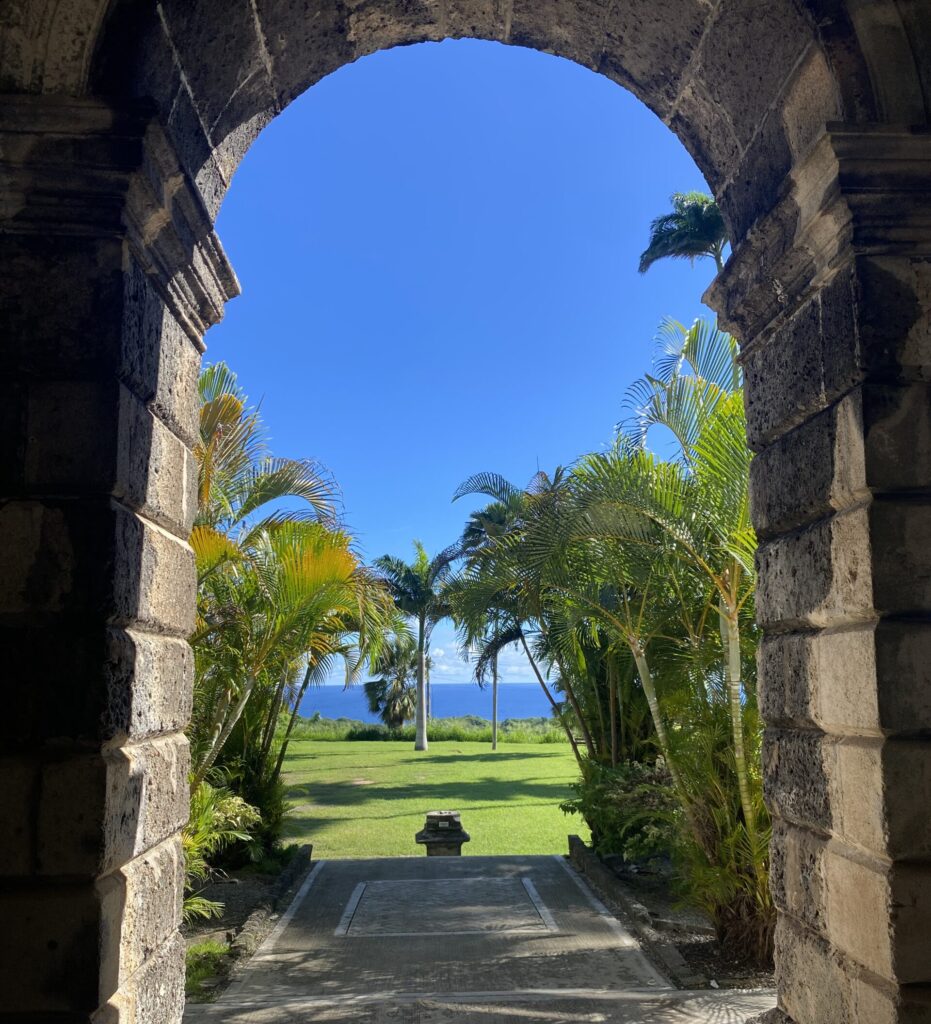
Image: Looking out from Codrington College, Barbados.
Richard Llewelyn Arthur (Uncle Lew) and The Revd Levon Alkins are both descended from Africans who were carried across the Atlantic and forced to labour on plantations in Barbados. They are both intimately connected to Codrington College, Uncle Lew from having worked there since he was 13 years old, and Revd Levon from being a very recent graduate. These are their reflections on the links between Codrington, the church, and slavery.
Listen to the interview with Uncle Lew (approx 10 mins)
Audio Transcript
I am Evie Vernon with USPG, the United Society, Partners in the Gospel. USPG is, if you like, a direct descendent of the Society for the Propagation of the Gospel, founded in 1701, which as part of its history owned slaves on the Codrington Plantation. And we’re here, talking with some who hold that legacy of history by their association with Codrington College and the Codrington Plantation. I will first ask Uncle Lew to introduce himself.
My name is Richard Llewelyn Arthur, but here at the college, they call me Uncle Lew.
What’s been passed down to you? What have you heard about this history of Codrington College? And the fact that the church, and the mission society of the church SPG, owned slaves?
I heard that they owned 300 slaves. And they had an outbreak of cholera and then that they had buried some of the slaves in a mass grave down the hill from here. And there are two sites, as far as I understand, that the slaves was buried. Dr Lawfield from the University of North Carolina, he came down here as an archaeologist, digging. He was looking for the remains of the slaves, like what they used to use and things like that. So, we did at that time find some skulls in the area where the graves were supposed to be located.
We understood too that, actually, the slaves was actually the first slaves that that was able to go to church because Society Church, up the hill, which is Holy Cross Church, we call it Society, but it’s Holy Cross, that that church was built for the slaves. And in a recent service, I heard that each stone that built that church was laid by slaves. Every slave bring a stone. So, every stone in that church is laid there by a slave.
The slaves used to live around the area in the back of the college, you know, and actually the Society School, I understand actually was built for the slaves. I understand that is where the slaves’ children went to school at Society. Unfortunately, it get closed a few years ago. Which I understand it is the oldest school in the Caribbean. You know that Society School, but it had closed a few years back. And it didn’t go down too good with some people in the community.
What did they say?
That it should never be closed because they even had some ones (sic) that when past students went there, came back and said that (sic) school produced a lot of prominent people in society and they didn’t (sic) too pleased knowing that it had closed down.
Uncle Lew, you’ve been associated with this college for a long time. How did you get involved here? Well, my great aunt, a lady by the name of Gladys Nurse, was the head cook here at this college here, way back. And the Mirfield fathers, then it was Fr Jenrick. The Mirfield fathers came here in 1955, the same year as hurricane Janet. And they used to bring my great aunt home at lunchtime, and my mother had passed away around 1960. So, I was around my great aunt. And the Mirfield fathers used to come over, and one day they asked me, “What am I doing?” And my great aunt said, “Well, his mother ain’t too long passed away, and presently he is doing, you know, he ain’t doing anything”. So Fr Jenrick tell me I could come over to the college the Monday morning and let he see if there is anything that I could do.
I was on a 24 hour call. I would be at home and people would call, Lew, I in trouble. And many students I had to take to the doctor and different places to make sure that the students were all right, because the students ‘come like a part of our family.
So how old were you when you first came?
Well, when I first came here, I was about 13 years old, but then I had to leave and come back. And when I came back on staff, I was about 14. Back then you could only come into the college if you had business, because this whole place was fenced.
[Years later] They had some parents in the area came to the principal and said, “Our children don’t really have any place to play.” So there was a Saturday class, at the time that the principal was teaching, and he raised with that Saturday class that the children in the area didn’t have anywhere to play. And out of the Saturday class they raised some funds, and he took it to the sports council and they had erected a little park for them.
So what I’m hearing you say, is that [there was] a movement to make this Codrington more involved and responsive to the community?
Even back with the Mirfield fathers, Holy Cross, you see, when they came here, Holy Cross Church, up the hill, was a part of the college. So, the AYPA, that you talk about today, the Anglican Young People’s Association, and I remember that is where that was formed.
Uncle Lew, any final words of what Codrington has meant to you and your family over the years?
Well, Codrington ‘come like actually home to me. Because all my life, I could say that I was here. And since that I had so much responsibility. I was called upon to carry out so much, it ‘came as part of me. Because I remember talking to a student sometime back and he said to another guy, you know that Lew used to be in the college and the principal gone to sleep. And they would call me, all one o’clock and say, “Come over.” And I come over, interact with the students.
The College is a good place. I would like to see it keep the doors open.
Session Three – Codrington Legacies continued
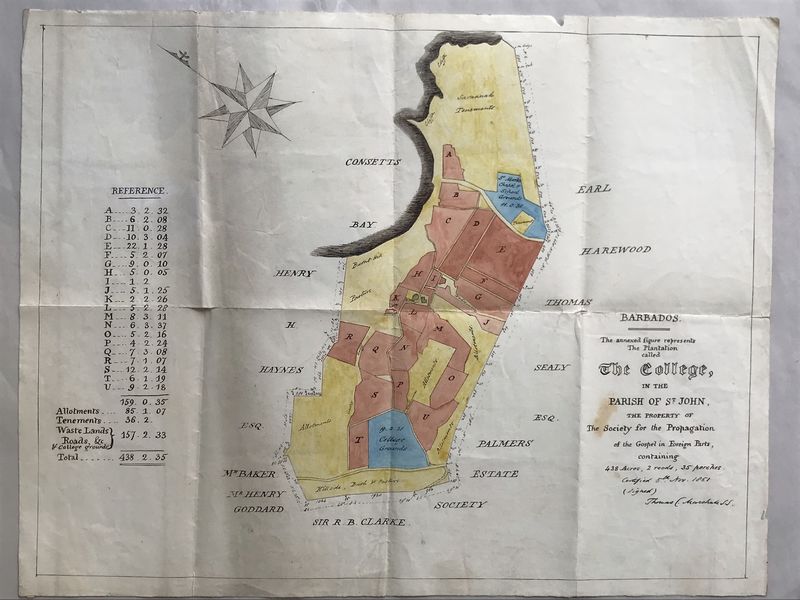
Image: Map of the Codrington plantation, called ‘The College’ in the Parish of St. John’s, Barbados. 5 November, 1851. Find out more: http://emlo-portal.bodleian.ox.ac.uk/exhibition/uspg/items/show/72
Listen to the interview with The Revd Levon Alkins (approx 7.5 mins)
Audio Transcript
The new generation, The Revd Levon.
Hi, I am Revd Levon Alkins, I am the assistant curate of St Leonard’s Church, Westbury Road, St Michael, and a past student of Codrington College, only graduating this year 2023.
Revd Levon, in terms of the church and feelings that people of your generation might have, looking back at that history, and saying okay, church owned slaves; what are the feelings in your generation? What do people say?
When we think about, generally think about, the church and slavery, we look at it from an unfortunate point of view, where, how could someone who is promoting the gospel promote slavery? Promote this kind of bad behaviour and promote this uncaringness to these people? People who are not even seen as human beings, but were seen as possessions, as things. So, when younger people think about the church and the church owning slaves, it is from a negative point of view. They have bad things to say. They don’t even want sometimes to get involved in the church or church work. So we can look at it from two perspectives, so when we say, when young people say, “No we don’t want to go to church, because the church upholds something that wasn’t right.” Although some people will say that when we read Holy Scriptures, we see slavery happening in biblical times. Because even when we look at the story of Pharaoh, when Pharaoh kept the Egyptians/the Israelites in bondage in Egypt. So, to be fair to the younger people it is their view from the perspective that they got from learning history that they now have this understanding and have this negative connotation towards the church.
Okay, so it’s a feeling that perhaps the church, while saying that it’s in favour of love and brotherhood and sisterhood, actually condoned and promoted the opposite of that?
Correct. So, on one hand the church says you have to love but yet on the other hand, the church is treating people without love because we are using people for labour to gain profits which is a contradiction. And if we going to have a contradiction then what is the sense [in] coming in the church? That’s what younger people would ask. I can just stay home and you know, live a peaceable life, without being in bondage to the church who upholds the wrong things.
Could you say what made you come to Codrington. What inspired you in terms of present and being involved in the church?
I grew up in church from the time when I didn’t even know myself. So, growing up in the Anglican Church, I was able to be inspired by many members of the clergy, including a past principal of this said college, who, through him, I actually knew about Codrington College. Because, at the time, he was assisting in the church that I was a part of, and he used to tell us about theology and the courses that would be on at the college. So, being the curious person that I am, I actually went and found out about Codrington College and asking (sic) questions about Codrington College. Also, I had a keen interest for serving at the altar, and eventually I wanted to become a priest. So, knowing about Codrington College, I then asked, “But how [do] you become a priest?’ Well numerous priests told me, “Well, you have to go to the historic Codrington College.” So, ever since then, I wanted to come to Codrington College. I would visit and go by the lake and do other things at the college. But it was only in recent times that I really considered the call of, of coming to Codrington College. And I made that step in 2019, when I decided to take on the Bachelor of Arts in Theology. And then, soon after coming in as a seminarian, here at Codrington, and here I am today, being an ordained deacon in the Diocese of Barbados.
So, for you there is, as a young person, relevance for the church, despite your knowledge of the history.
Well, despite the fact that Codrington College had slaves, we now in the 21st century must go beyond this and look at it as an institution of what Christopher Codrington had in his will, where he wanted a school of spirituality and a school of medicine. This institution of Codrington College is the institution where one can come and learn about spirituality. So, we must not dwell too heavily on the past, but look into the relevance for the future of how this institution can inspire young people like myself for centuries to come. And, you know, we need to build on the foundation that has been set by the ancestors, who were able to give us this opportunity of giving us an education and of learning about theology, learning about God, learning about faith, which most ancestors from in slavery times didn’t have this opportunity. So, I think that we, in this present age should make the most of this opportunity.
Any final words?
Any final words would be to let us keep on the legacy of this place, this Codrington College which has educated so much (sic) priests and laypersons across the Province of the West Indies, and even beyond the West Indies. And so, I would like to see this institution go higher and higher and to build a stronger relationship with community and with the wider jurisdiction in the world.
Session Four – Legacies for the Future
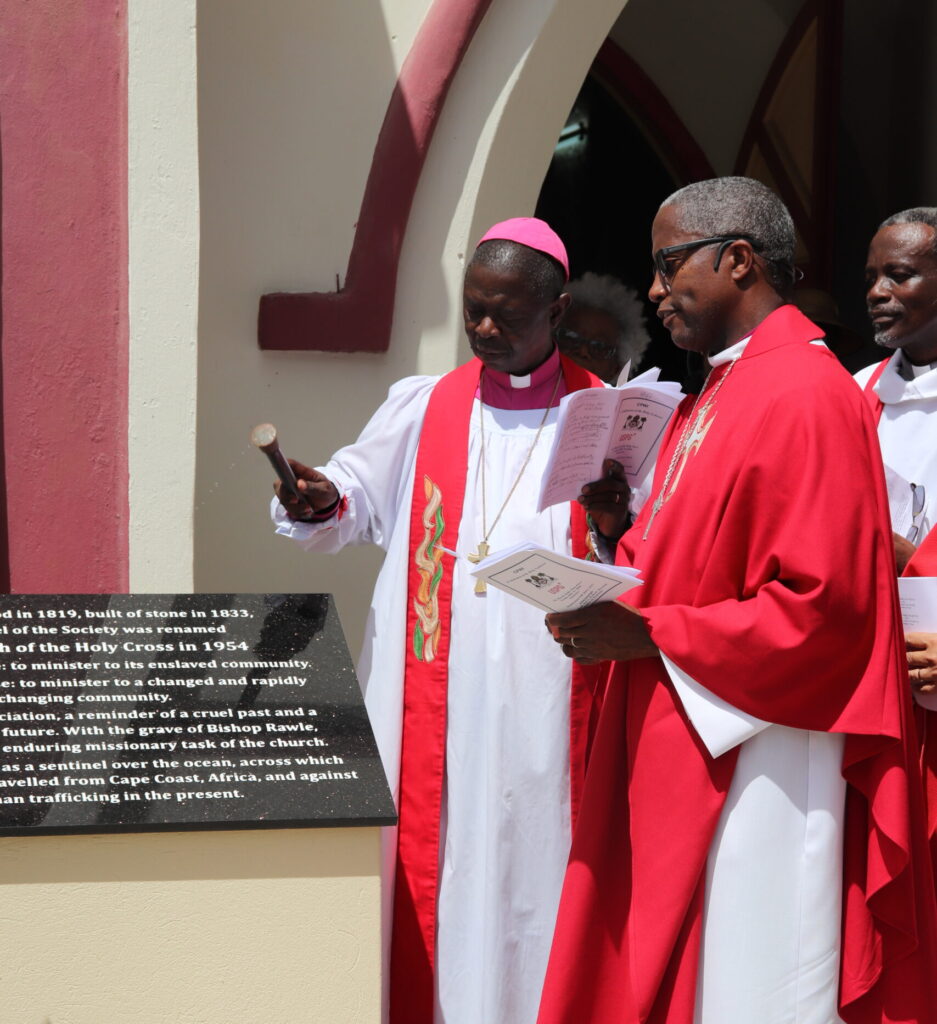
Image: The Most Revd Dr Daniel Yinkah Sarfo, Archbishop of the Internal Providence of Ghana and Bishop of Kumasi in the Church of the Providence of West Africa blessing a a commemorative plaque outside The Church of the Holy Cross in Barbados a reminder of the cruelty of slavery and the Church’s commitment to a more just future. Barbados, 2019.
Listen to Dr Evie Vernon (approx 9 mins)
Audio Transcript
The world came to the Caribbean and the furnaces of slavery and empire fused the disparate heritages into new and vibrant cultures. Caribbean people brought to the world fresh and innovative approaches to religion, language and music. They excelled in art and literature, science and sport, politics and philosophy. Marcus Garvey, Toussaint L’Ouverture, Mia Motley, Nanny of the Maroons, Fidel Castro, Franz Fanon, Bob Marley, Usain Bolt, Shelly-Ann Fraser Pryce, Jean Binta Breeze, Frank Collymore. The litany goes on and on.
And yet the challenges remain. For the most part the former colonial powers have departed, having granted a form of independence to most of the territories. But it is worth reiterating that the purpose of empire was to extract resources from the conquered to enrich the elite of the conquerors. The great wealth which was produced in the Caribbean went to enrich Europe, while the Caribbean was left with a legacy of enormous debt, and poorly developed education and social structures. The enterprise of the plantation economies devastated the land, decimated the indigenous people, and left behind a workforce who had been compelled to be subservient.
And yet the people of the Caribbean have been courageous, resilient and creative. But they cry out for justice. One regional grouping of nation states, the Caribbean Community, CARICOM, have called for reparations from Europe. They have put forward a 10-point plan for reparatory justice.
This is their preamble:
The CARICOM Reparations Commission (CRC) asserts that European governments:
- Were owners and traders of enslaved Africans.
- Instructed genocidal actions upon indigenous communities.
- Created the legal, financial and fiscal policies necessary for the enslavement of Africans.
- Defined and enforced African enslavement and native genocide as in their ‘national interests’.
- Refused compensation to the enslaved with the ending of their enslavement.
- Compensated slave owners at emancipation for the loss of legal property rights in enslaved Africans.
- Imposed a further one hundred years of racial apartheid upon the emancipated.
- Imposed for another one hundred years, policies designed to perpetuate suffering upon the emancipated and survivors of genocide.
- And have refused to acknowledge such crimes or to compensate victims and their descendants.
Context
The CRC is committed to the process of national international reconciliation. Victims and their descendants have a duty to call for reparatory justice.Their call for justice is the basis of the closure they seek to the terrible tragedies that engulfed humanity during modernity.
This is the Ten Point Plan for Reparatory Justice as set by the CRC:
- Full formal apology. First there must be a full and formal apology. Generalised statements of regret are not enough.
- Repatriation. Over 10 million people were stolen from their homes in Africa. International law and diplomacy must be deployed to resettle those descendants who wish to return, with due consideration for citizenship and integration into local communities.
- Indigenous peoples development programme. European governments deliberately embarked on a campaign of genocide against the indigenous population, murdering them, enslaving them and confiscating their land. These issues must be addressed for the benefit of their surviving descendants.
- Cultural institutions. Museums and cultural heritage sites in the Caribbean must be resourced in order to serve and educate Caribbean people.
- Public health crisis. Caribbean people suffer a tremendous public health burden of chronic diseases, with the highest rates of type 2 diabetes and hypertension in the world. The scientific evidence attributes this to the nutritional poverty and the physical and psychological stresses coming from the experience of slavery. European governments need to take responsibility to repair this aspect of their legacy.
- Illiteracy eradication. European governments left behind a legacy of illiteracy and underdevelopment. In the 1960s, when most Caribbean governments were gaining independence, approximately 70% of their African-descended populations were illiterate. Caribbean governments have had to spend more than 70% of their revenue to address illiteracy and public health issues.
- African knowledge programme. African-descended people in the Caribbean have been forcibly separated from their roots and deliberately kept ignorant of their heritage. Programmes need to be developed to address this void.
- Psychological rehabilitation. The experience of slavery has imposed incalculable psychological stress and damage upon the psyches of Caribbean people. Programmes to address this must be put in place as a matter of urgency.
- Technology transfer. The Caribbean was confined to the role of producing raw materials for Europe and was not allowed to be part of the technological revolution. This has cemented its place at the back of the economic development bus.
- Debt cancellation. Europe’s legacy to the Caribbean of underdevelopment and poor public infrastructure has led regional governments into a debt trap, with them owing billions to the same states that left them so critically under-resourced. European nations need to cancel international debt and support the repayment of national debt.
In short, the call for reparatory justice is about far more than monetary compensation for the wrongs of the past. It is about putting in place measures in the present which will ensure a fairer and more balanced world for the future.
The Church and church organisations were heavily implicated in carrying out the evil doings of the past. They must wholeheartedly be involved in repairing the present to create justice for the future.
Os hoffech wybod sut rydym yn casglu, prosesu, storio a rhannu data, gweler ein Hysbysiad Preifatrwydd